Monday, July 26, 2021

Charles Cossill and Pourewa - What we know and don't know - so far (Part 1 - revised)

Charles Cossill and Pourewa (later known as Margaret) are the ancestors of hundreds of descendants around the world. You may well be one of them. If you are interested in connecting with other Charles and Pourewa descendants, feel free to request membership of the (private) Charles and Pourewa Cossill Descendants - All Facebook page.

Charles and Pourewa's grave and memorial (1994) 

Pourewa's ancestry and her marriage to Charles have been well researched by Cousin Nigel Cooper in his book Ngā uri o Pourewa: a Pākehā family discovers its Māori ancestry - an updated sequel to Ngāti Māhanga - a Pākehā family search for their Māori ancestry. I continue to express my gratitude for his tireless efforts over many years to search for and share the facts and details we now know about our mutual ancestors. Just about everything we know about Pourewa can be traced back to Nigel's research. The books are no longer in print, but copies may be accessible through libraries or second-hand book traders. They are well worth having, and an update with new information is being planned by Nigel. If you have anything at all you would like to contribute, including family anecdotes, photos and family tree information, please contact me via the email tab on this page. It would be great to have all branches of the family covered.

Charles' ancestry and his life before he came to New Zealand is obscure, and it has been difficult to discover anything verifiable.

The purpose of this post is to gather what is known about Charles - with evidence - and to separate out what has been perpetuated as fact but has no supporting evidence. It may be that someone has relevant information or evidence, and it would be so wonderful if this came to light. Family stories and anecdotes are valuable clues, but we have very few of them to work with. They may not be entirely reliable, as versions can change over time, and facts could have been altered or never shared with following generations. But they are a start!

In the meantime, it may be possible to learn more about the life and times of Charles, Pourewa and their family by placing them in the context of histories and publications of the times. Any speculation will be clearly identified as such, and this post will be edited and updated if new facts come to light. I am happy to be proved wrong or challenged on any of my information, as it can only help to get to the real story of our ancestors.

This post focuses on the "where?", "when?" "what?", and "who with?" of Charles in the early days of his arrival in New Zealand. His life with Pourewa and family will be the focus of the next post.

In Richard Cossill's obituary (November 1931), it states that his father Charles was from Suffolk. Charles must have told his family this, as it's unlikely they would know from any other source. Most online family tree and research records state that Charles was born in Rattlesden, Suffolk, either in 1800, 1808 or 1810. I would love to know where the Rattlesden information came from and who added it first, as they might have the evidence to prove this.

Location of Rattlesden, Suffolk

I have searched all available online births for Rattlesden and Suffolk - and for Charles Cossill and variants of its spelling - and can find no record to support or confirm this. Neither can I find any evidence of any Cossills - or variants - in Rattlesden or Suffolk births, deaths and marriage records in the relevant time frame - or with any hint of a connection to our Charles' ancestry. I even searched Australian shipping lists, and Australian convict lists  beginning with the letters C, K and G, supposing Charles came to New Zealand from Australia - but no luck. 

Fun fact: Henry Rosieur, the husband of Charles and Pourewa's daughter Maggie, was born in Stowmarket, Suffolk, about 8 kilometres from Rattlesden. 

Richard's obituary also notes that Charles was a sailor. It's possible he did leave England as a sailor, but it could be that it was a means to an end, and once he was on land, sailing was for getting from A to B, as he seems to have been very much land based from what information we have. There would have been work on sailing vessels had he been a mariner by choice. It is difficult to imagine that he was a sea captain - as has been suggested in some information - as we can safely assume he was illiterate from his not being able to write his name on his marriage registration. Literacy must surely be a prerequisite to be a sea captain.

Also in his obituary, there's a brief nod towards Richard's Māori ancestry with a romanticised mention of Charles falling in love with a native lady. It is interesting to note that even after 95 years since the marriage (1836 - 1931), the family (who must have contributed the information for the obituary) were still well aware of the historical significance of the marriage, including that Bishop William Williams officiated - even though he didn't become a bishop until later. This must have been a commonly known story within the family - and must have been retold with a certain amount of pride by either one or both of Charles and Pourewa for it to have endured and been considered as worthy of inclusion in their son's obituary nearly 100 years later. 

I have also looked for clues in DNA matches through Ancestry.com and My Heritage. The great news is, it's fairly easy to identify DNA matches with other descendants of Charles and Pourewa. The exciting news is that some of them were never aware of this side of their ancestry, and it's been wonderful being able to contact them and share information. The bad news is that I can find no obvious connections or clues to either Charles' or Pourewa's ancestry - yet.

Note: If you are a Charles and Pourewa descendant and have had your DNA tested, note that you may well show high cM matches with many other people with varying degrees of Polynesian ancestry with no connection to New Zealand or likely connection with Pourewa. This is more to do with the limitations of the methods used to measure and analyse data and to recognise and use data from smaller ethnic populations. Because of the limited number of Māori arrivals to New Zealand over time - and the country's geographical isolation - as well as the limited and isolated nature of their homeland population - it is overwhelmingly likely that any one with Māori /Polynesian ancestry had an individual ancestor multiple times. This is not able to be accommodated in DNA testing at present, the upshot being that some of the results can be skewed. There's a whole lot more science behind that if you want to investigate more.

Neva Clarke McKenna, in her book Mangonui - Gateway to the Far North, writes that it was thought that Charles came from Suffolk, England, and she probably used Richard's obituary as a reference. She includes variants of the spelling of Cossill from other sources: Cossall, Cossell, and even Copele. 

Fun Fact Update: information recently shared has evidence that Charles and Pourewa's daughter Mary (Buchet's) maiden name was given as Copel on her marriage certificate, even though Cossel was recorded on her intention to marry. Similarly another daughter Margaret (Rosieur) used Copell as her maiden name on her intention to marry and her marriage certificate, even though her mother's name is given as Margaret Cossell giving permission and witnessing the marriage. 

Richard Cossill's obituary states that Charles came to New Zealand on a brig to load spars at Hokianga for the Imperial Government.

McKenna also writes that Charles Cossill arrived in New Zealand in 1831 or 1832 on Captain Ranulph Dacre's schooner The Darling captained by John Skelton. I'm not sure where she got the information that Charles was on board, but it must be available somewhere - probably in the sources listed in her bibliography. Captain Ranulph Dacre had visited the Hokianga in 1827 to take a load of spars, first on the Surrey and later his own vessel the Lucy Ann. There are records of 11 (unnamed) sawyers permanently settled at Mangamuka by 1834, attached to the shipbuilding yards at Horeke (Hokianga Harbour). Elsewhere it is recorded that in 1831, Dacre had a contract to supply 100 spars to the Admiralty. Skelton bought land on Dacre's behalf at Mongonui and Mercury Bay, but the entire company fled when attacked by Māori. Subsequently, Dacre organised Gordon D Browne to complete the contract. If Charles was with Dacre's group he would have had to have been in Australia already, and would have returned, as indicated, with the entire company. If he was in Browne's group, he still would have left from Australia, but may have stayed on in New Zealand afterwards.

Captain Ranulph Dacre

It is possible that Charles could have come to New Zealand several times before he finally settled here. There is still more research needed to get a concise timeline of events and movements.

Timber export sites 1829 - 39 (From Logging Native Forests - Encyclopedia of NZ)

The online biography of Stephen Wrathall (senior) gives us some of the only recorded evidence of Charles Cossill and an enticing insight into who he might have been. Wrathall's account doesn't entirely match dates, events, locations and details in family trees, nor other records and published information. It was written by descendants transcribing his diary but still gives us a few names, places and contexts to work with. Wrathall's story also reads as if he was a major player in the founding of pre-colonial enterprise in several places in Australia and New Zealand, but it is difficult to find corroborating evidence. There are few dates included in the biography, and some are wildly inaccurate, but shipping records place the Wrathall family arriving in Hobart, Tasmania, from England in April 1831. Neva Clarke McKenna notes, however, that Stephen Wrathall was a member of Ranulph Dacre's party arriving in New Zealand on the Darling in the early 1830s to collect spars. (Wrathall's biography doesn't mention this.) Again - more research is necessary to tease the facts from the fiction.

Note: Read the comments at the end of this blog for a suggestion that Wrathall's book was a work of fiction - which explains the significant inaccuracies. Still, it gives names of real people who were there in the early years of European contact. It was still useful to read the fictional biography, as I discovered more facts by trying to verify the details than if I had ignored it completely.  I leave my findings as written below and alert readers to be wary of using any of Wrathall's story as fact. Still, it remains a jolly good yarn. 

McKenna also states that the group of sawyers sent to Taipa in 1831 set up  sawmills and married Māori girls. This certainly could be a likely context for Charles and Pourewa meeting - although it doesn't quite fit with the version of all Dacre's men packing up and returning to Australia after being attacked by Māori. McKenna may not have had access to Wrathall's biography - or was aware of it and discounted it -  as it does not appear in her bibliography.


Taipa, Mangonui and Paewhenua Island

According to his story, at some stage in the early to mid 1830s, Wrathall Senior with two of his sons, Stephen Junior and John, set out for New Zealand on the schooner Mary Ann to bring goods to trade with Māori. Anchoring at Doubtless Bay, he saw immediate opportunities in the tall kauri trees which grew right down to the water's edge. Inexplicably, this is dated in his diary as November 8th 1812 - when, clearly he was still in England. He arranged with local chief Pawai to "buy" land at Taipa in exchange for goods which he had brought with him for the express purpose of establishing an ongoing relationship of mutual benefit with the chief. I can find no other reference to Pawai in online records apart from a single mention in Papers Past in relation to a group of Māori disgruntled with a land sale in Manganui [sic] attributed to him. His name does not appear on the Treaty of Waitangi,

The story continues that having established a base at Taipa, and gaining further access to land, Wrathall senior sent the captain of the Mary Ann back to Australia to bring back more goods, equipment and personnel to set up his timber milling operation. According to his dairy, Wrathall requested the captain bring back Berghan, Beldon, Flavell, Snowden, Rosieur, and Downes. He also arranged for his head pitman, Cossil [sic], to come back and bring with him four 10-foot heavy plate saws, twelve 8-foot and ten 6-foot medium plate saws, and 12 crosscut saws ranging from 7 to 10 feet. It was Cossil's job to see that suitable men were engaged to come to New Zealand. It is clear that the afore-mentioned men were already known to, and probably employed by, Wrathall in Australia. Only surnames are used, but it likely that the Cossill mentioned is based on our Charles Cossil. This is where it gets interesting, though, and the timeline goes awry - Henry Rosieur was in born 1826, UK and married Charles and Pourewa's daughter Margaret (Maggie) (born 1843). Rosieur's name is not mentioned again? Similarly, the aforementioned Belden may be based on Thomas Marquis Beldon (born USA between 1830 and 1840) who married Charles and Pourewa's daughter Murilla. Again, there are many parts of Wrathall's story that don't add up, so any information taken from it would need some extra evidence for verification.

According to Wrathall, he and his sons remained behind in Taipa to set up their establishment in preparation for the arrival of the workers. Thirty-eight days later the captain returned with the order fulfilled, and with help of local Māori, everything was unloaded and everyone was settled in. Work began the next day, and continued uninterrupted. Wrathall employed enough "native" men to man the pits under Cossil's supervision, while Flavell and Snowden were placed in charge of bush felling and rafting operations. Cossil paired each Māori with an expert and soon all were proficient. Such was the quality and quantity of the timber that the makeshift huts and store rooms were replaced with wooden structures and shelving. Pawai visited and, according to the biography, was impressed with the results and was "pleased to know that [his men] were doing the work to the satisfaction of Wrathall's foreman" (our Charles). Pawai and Wrathall negotiated further land at nearby Orutu (Oruru) (about 800 acres) in exchange for goods and services (including the erection of buildings for Pawai). Wrathall decided to use the land for pasture and returned to Australia to make arrangements to bring more goods - and cattle - back to New Zealand.

Note also the degree of responsibility and leadership that Cossil appears to have had. Surely he would need to be literate to carry out Wrathall's expectations? This doesn't fit with the simple cross on his eventual marriage registration.

According to the biography, Wrathall exhorted his sons Stephen and John to maintain good relations with Pawai and the natives. He foresaw significant entrepreneurial opportunities for himself and his family by being amongst the first to establish trade and land acquisition. Even so, his biography portrays him as an honourable man of integrity who insisted on open, honest and fair dealings with Māori and all his workers, and who may have exploited the natural resources but not his workers. It seems he certainly understood how to keep his customers satisfied.

ACcording to the story, Cossil, as foreman, was left with various instructions and was entrusted to continue the enterprise in Wrathall's absence, including having another load of flitched timber ready for the return of the Mary Ann. Pawai had promised to send more men to help if needed, and Wrathall had secured his protection of the establishment during his absence.

Wrathall duly returned with cattle, sheep and horses, much to the amazement of the local Māori who had never seen such like before, and son John was charged with establishing the farm at Orutu (Oruru). And so a booming trade began - with no money in circulation - with Māori being able to absorb all the goods brought from Australia on the return trip from delivering timber.

Such was the mutual benefit that Pawai and Wrathall saw in securing a long-term relationship with each other, that Pawai offered Stephen Wrathall Junior a high-born woman, Marae Inototo (some variant spelling), as a wife - which he accepted. The marriage took place in 1833 according to Wrathall family tree details, some include Rawene as a location. If the marriage was formalised by a minister of the church, it would easily pre-date Charles and Pourewa's record-holding interracial marriage status. The biography suggests that this happened in the early 1820s which is clearly wrong, and also that their first-born child, Anne (born 1835 according to Wrathall family trees) was the first European child born in New Zealand - totally ignoring her Māori heritage through her mother, let alone the numerous missionary children of 100% English parentage born well before this.

This brings it up to about the time of Charles and Pourewa's marriage in 1836. 

Although the biography does not mention the Treaty of Waitangi, it certainly alludes to its inevitability and its aftermath. This helps place the events in their chronological context - which, again - is out of kilter with the few dates that are given. The consequences of the Treaty certainly had an impact on the Wrathalls as their land had to be surveyed and ownership verified. According to the story, Stephen junior's cattle farm at Orutu (called Pawai block and misspelled Parawai Block, and which seems to have increased in acreage since its original purchase) was reduced to 1500 acres of the original 10,000 acres, but he was allowed to pay grazing rights for the remainder.

The pre-Treaty currency of barter was replaced with the coin of the realm, and Wrathall, according to his story, was then able to pay his workers in both kind and coin. As town sections became available in Mangonui, Wrathalls bought up several of them and built the Donnybrook Hotel on one of them in 1842. Wrathall wrote that he put Flavell, one of his original bushmen, in charge of running it, with enough credits from his Taipa bush work to pay a two-thirds deposit. The hotel was to become famous - or infamous - and well patronised by locals and visitors alike. Similarly, Wrathall started one of his sawyers, Downes, in a hotel called "The Donkey's Nest" in Whangaroa. The story states that Cossil was set up with a cottage and an area on the island at the headwaters of the Mangonui Harbour and the balance of 700 pounds in cash. This is Paewhenua Island where Pourewa is buried, so there is clearly some recognised proof of the early connection between the Cossills and the island - but Wrathall's part has yet to be validated. Snowden was given two bush areas, one in Whangaroa and one at Oruaiti Stoney Creek plus 200 pounds cash. Berghan was given a block of land at Taipa Heads and an area at Pararanui, with 100 pounds cash settlement. All the above-mentioned land had gradually fallen into the hands of Wrathall senior as the results of advances of provisions to Pawai under the bartering system.

The story states that the original party of sawyers and bush hands had all married Māori women and were all living in the Whangaroa and Mangonui districts - with numerous offspring all well known to subsequent settlers. This is a credible explanation for where Charles and Pourewa could have first met, although there are other factors still to consider. Wrathall decided it was time to take stock of, and wind up, his businesses and had Mr Beldon, his chief clerk, organise the paperwork so that he could leave his two sons financially independent in New Zealand and return to live out his last years in Australia.

On the evening prior to Wrathall's departure, an almighty farewell dinner was held at the Donnybrook Hotel. No doubt Charles would have attended this, as it is noted that Downes of the Donkey's Nest and other leading citizens and friends as well as three Nga Puhi chiefs were present for this reunion. Apparently the party lasted for three days even though Wrathall left for Australia after the first night, and that it was an event remembered for many years to follow.

Fun Fact: Sarah (Sally Wells) who married Charles and Pourewa's son Richard Cossill, was the sister of Elizabeth Wells who married Stephen Wrathall III, son of Stephen Wrathall and Marae Inototo, and grandson of Stephen Wrathall I who employed Charles Cossil at Mangonui.


Timeline of some relevant and verified dates:

Includes random and unconnected information as discovered.

- 1827 Ranulph Dacre takes his first load of spars from the Hokianga Harbour (after reconnaissance visit in 1825)

- 1831 European settlement begins in Taipa, with Ranulph Dacre bringing schooner Darling to Taipa river mouth to load spars. Stephen Wrathall was one of the crew  and was first white settler in Taipa, although was moved off by Ngapuhi.  (Charles Cossill presumably part of Dacre's party.) [Mangonui Sewerage Report, 1988, p.23, 3.5]

- 1832 Dacre opened large scale trading operation at Hokianga.

- 1836: (October 20) Charles and Pourewa married in Waimate Parish by William Williams

Late 1830s, Pororua and Kiwa, Ngapuhi chiefs, granted Butler, a former whaling captain, use of the Paewhenua Island and Pukakawa blocks in Mangonui harbour.

- 1839: by 1839, at least 11 resident sawyers living at Mangonui.

This is clearly a work in progress and will be edited, amended or extended as new information arises. Hopefully, it will help us get to know a little bit more about Charles and Pourewa and the world they lived in.

Sources:
Ngāti Māhanga - a Pākehā family search for their Māori ancestry by Nigel Cooper (1990)

- Ngā uri o Pourewa : a Pākehā family discovers its Māori ancestry by Nigel Cooper (2005) 

- Mangonui Gateway to the Far North by Neva Clarke McKenna (1990)

- New Zealand Births, Deaths and Marriages Online (NZBDM) 

- Papers Past 

- My Heritage 

- Ancestry.com 

- New Zealand: the first British arrivals, 1769-1839 - Jock Phillips 

- Ranulph Dacre and Patuone's Topknot - Frank Rogers. (Stout Centre Review March1995)

- TOITU TE WHENUA E Only the land remains, constant and enduring.  Muriwhenua Land Claim (Wai-45) A Preliminary Report on the Historical Evidence Barry Rigby and John Koning Waitangi Tribunal Division 4 December 1989

- INTERMARRIAGE:  ITS ROLE AND IMPORTANCE WITHIN EARLY NEW ZEALAND SHORE WHALING STATIONS. A thesis in partial fulfilment of the requirements for the degree of Masters of Arts in History at Massey University, Emily V. Owen (2007). This can be found on Google Search but links don't work for downloaded documents

Transcription of the Biography of Stephen Wrathall (1779 -1872)

 - Whakawhanaungatanga Using DNA, Part 1 of 3: It's Complicated (Easy to find links to Parts 2 and 3 from here). Can thoroughly recommend this, and I know the person presenting the webinar. 

-  Marriage in Early New Zealand (from  Matters of the Heart: A History of Interracial Marriage in New Zealand, by Angela Wanhalla) 

- The New Zealand Timber and Flax Trade 1769 - 1840 by Roger Phillip Wigglesworth (1981)

- Logging Native Forests  - Encyclopedia of NZ - summary of information covering this period.

Mangonui Sewerage Report, Waitangi Tribunal (1988)  


Friday, July 16, 2021

In Search of our Cousin Kate Harris

Unbeknownst to all  of us, it seems we have a long-lost, long-deceased distant cousin - a daughter of William and Mary (born Herd - and variants) Harris

                                                      
                                              Mary Harris born Herd 

William Harris 

Photos from Harris/Leathart  family photo album. 

I found Kate Harris when I was looking for burial records at Saint Peter's Anglican Church, Onehunga, Auckland (NZ).  There's a particularly thorough and well researched site called Grave Insights Onehunga which has wonderful information on the church and many of those resting there permanently. 
Saint Peter's Anglican Church, Onehunga, 1860s 
Sir George Grey Special Collections,  
Auckland Libraries, 957-192-1.

Saint Peter's Church mid 1860s - as it would have been in the times of the Harris family. 

I was checking out the details for our Harris founding ancestors William and Mary when I found this in the cemetery records:


Kate Harris
, no date of death, buried 24 November 1864, aged 6 years 6 months, daughter of William and Mary Harris

 From NZ Births, Deaths and Marriages records (NZBDM), she was born on the 19th July, 1858. If you open the cemetery records link, scroll down to page 22 to find this entry. 

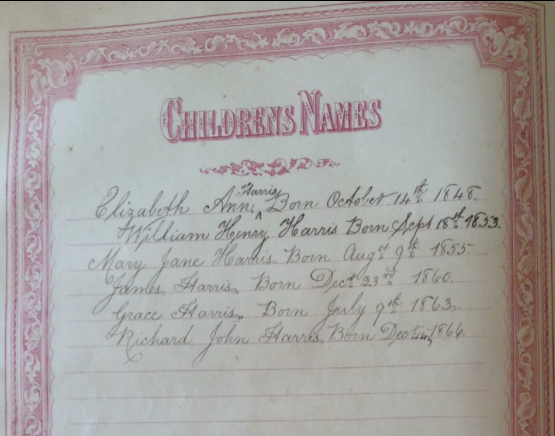
This was a complete surprise to me, as I thought we hade a clear and accurate record of all of  William and Mary's children, both through parish records, NZBDM records and a page of family dates in the Harris family Bible. 

I can confirm that this is our William and Mary Harris of Onehunga. The NZBDM does, indeed, confirm the year of birth, name and parents of Kate.  (The church must have got access to the original NZBDM record for confirmation.)  

Snapshot of the entry in NZBDM.

For further confirmation, I sent for a copy of the original, and was delighted and relieved to see that it included Mary's maiden name (formerly Heard), thereby confirming beyond any doubt that this was our William and Mary - with the inclusion of "Auckland" as place of birth for good measure - although where in Auckland is uncertain. 

From this record, we can conclude that Mary would have been pregnant throughout her voyage to New Zealand. We can only imagine what it must have been like for her! 
Photocopy of original registration of Kate's birth. 

I next tried to find confirmation of Kate's death and order a copy her death certificate. 

And this is where I hit a brick wall.  

There is no record at all of her death in NZBDM. I tried spelling her surname  a variety of ways in case there could have been a transcription error - but no joy. I also searched all deaths in Auckland in November 1864 (on ancestry.com) but again, no luck, although their records are likely to have come straight from NZBDM.  I went to the Auckland Central Library to check through 1864 deaths on microfiche, but nothing.  It is a hand-written list, in alphabetical order, of all the deaths by name and a reference number but no other details. 

The next step is to start to search out distant and, as yet, unknown Harris cousins, especially descendants of the older siblings of Kate, to find out if they know anything of her.  And to look for any other evidence of her life.

In the meantime - let's all add Kate to our family trees and the first Mary Jane if not done so already. 

Photo of Saint Peter's today from an interesting story of  Elizabeth Yates of Onehunga - the British Commonwealth's first "Lady Mayor", who is buried in St Peters Church. (Photo/ Stuff) Mayor in the time of our Harris family  living in Onehunga. 


Timeline of Relevant Dates 
Unconfirmed or estimated times are in italics.

Abbreviations:
OPC - Online Parish Clerks  Cornwall records
NZBDM - New Zealand Births, Deaths and Marriages
PP - Papers Past
NZER - NZ Electoral Rolls (Ancestry.com)

1847     
- 2nd May, William Harris and Mary Heard married at Warbstow, Cornwall. William employed as a servant. (OPC) 

Elizabeth Anne Harris born in 1847 according to her obituary (PP) 

-14th October - Elizabeth Anne Harris probably born (from birthday in family Bible) 

- 26th December - Elizabeth Anne Harris baptised at Warbstow. William's occupation is labourer, living at Penwinham (Warbstow)  

1848     
-14th October - Elizabeth Anne Harris born (according to family Bible entry) 

1850     
- March,  probable birth month of the first Mary Jane Harris (from OPC burial details). 

1851     
- 30th March, daughter the first Mary Jane Harris baptised at St Teath. Family living at Delamere and William's occupation given as quarryman. (OPC)

- 12th August, daughter first Mary Jane Harris buried at St Teath, aged 17 months, of Delamere. (OPC)

1852   
- 25th December, son William Henry Harris baptised at St Teath. Family still at Delamere and William still a quarryman. (OPC)

1853   
- 18th September, son William Henry Harris born (according to family Bible entry) 

1855    
- 9th August, daughter second Mary Jane Harris born (Family Bible) 

- 8th September, daughter second Mary Jane Harris baptised at St Teath. Family still at Delamere and William still a quarryman. (OPC) 

1857    
- 29th November, William and Mary Harris, son William Henry and daughter Mary Jane leave Plymouth, England, on the ship Joseph Fletcher. (PP)

1858     
-19th March, William and Mary Harris and family arrive in Auckland, NZ. (PP)

-19th July, daughter Kate Harris born in Auckland (NZBDM) 

At some stage not long after arriving in New Zealand the family settle in Matakana, North Auckland.
1860     
- 23rd December, son James Harris born (Family Bible) 

1861     
- son James Harris birth registered. (NZBDM) 

1862    
- family is living in Matakana (NZER - Northern Division) (1) 

1863     
- 9th July, daughter Grace born (NZBDM, Family Bible) 

1864     
- 24th November, daughter Kate Harris buried, Onehunga (St Peter's Church records) 

1866     
-14th December, son Richard John Harris born (Family Bible) 

1867     
- son Richard John Harris birth registered (NZBDM) 


Some ideas to consider

- The family Bible's publication date is 1872, well after all the children were born. Possibly an acquisition once the family had become comfortable enough to invest on one. 

- I'm not sure who wrote the names in the family Bible - that will be another task to check handwriting - but it looks as if they had all been entered at the same time -  as all children had been born by the time the Bible was purchased. 

- The name of daughter the first Mary Jane,  who was born and died in Cornwall, is not entered. This could be a hint to why Kate's name was not entered - perhaps because the Bible was bought well after Kate died. The omission of both deceased daughters' names, and that neither seems to have been remembered in any of our anecdotal family stories,  could be an indication of how William and Mary dealt with their grief. Maybe they just didn't speak of them. It could also be an indication of their deep faith and acceptance of God's will being done. 

-  I'm not sure why William Henry's year of birth is recorded in the Bible as the year following his baptism in St Teath.  We would need to go back to the original copy of the parish records to check that it wasn't a transcription error.  Could this also be the same reason that there is a year's discrepancy in the date of daughter Elizabeth Anne's baptism date (1847) and her birth date as recorded in the family Bible (1843)?  It could be a simple error of memory. The family must have known of the 1847 birth year as it is included in her obituary.  


(1) Information taken from objections to names entered in the 1862 Electoral Roll, Auckland, Northland Division.  William Harris's details are given as: abode - Matakana; nature of supposed qualification - householder; grounds to objection - has no household qualification.  Verification of this being our William Harris comes from Elizabeth Ann (Gillman's) obituary, which notes that the family settled in Matakana not long after arriving in New Zealand, but returned to Auckland during times of Maori unrest. That time has yet to be discovered. 


Sunday, September 13, 2020

Elizabeth Tinney and Elizabeth Cory - the Two Wives of William Harris (1755 - 1807) Part 1: The Side Track

Cornwall (Map from Wikipedia) 

The convenience of having a second wife with the same name as the first must surely outweigh any disadvantage. And so it may have been for (my) four-times great-grandfather William Harris. 

For the record: 
John Harris (1717-?) married Mary Luxon (1720 - ?) 
their son William Harris (1755 - 1807) married 2nd Elizabeth Cory (1750 - 1814) 
their son James Hodge Harris (1789 - 1865) married Grace Adams (1792 - 1862) 
their son William Harris (1823 - 1899) married Mary Herd (1825 - 1888) 
and they are our founding NZ ancestors. 

I decided to do some research on the life and times of William and his two wives, Elizabeth Tinney and Elizabeth Cory as there seems to be errors in some family trees I've researched, and some descendants' branches may have been attached to the wrong wife. So this is an attempt to sort out who is descended from whom.  But I got a bit sidetracked and ended up doing a lot of research on what was happening in the parish of St Gennys at the time of William and his parents' life there. Hopefully, you will find it as fascinating as I did that our ancestors certainly were living in interesting times.  Part 2 will move on to William and his wives. 

〰 〰 〰 〰

William Harris was the son of John Harris and Mary Luxon who married at St. Gennys, Cornwall, on 12th November 1741. His baptism was economically recorded as Wm., son of John Harris on Sunday 30th March, 1755, also at St Gennys, Cornwall. There is no record of his exact date of birth, which would have been near the time of his baptism,  as his age at death was recorded in the St Gennys parish burial records (2nd December, 1807)  as 52 years. This confirms his year of birth as 1755. 

Entry in St Gennys parish register for John Harris and Mary Luxon's marriage, November 12, 1741


A snapshot of the entry in the St. Gennys Parish register.  Wm Harris, son of John Harris 

There is a gap in one set of records of  the St Gennys parish baptism register between December 1741 and 1746, which could explain the lack of evidence of any recorded births for John and Mary Harris in the early years of their marriage. However, according to Cornwall OPC records,  there were 23 baptisms in St Gennys between 1742 and 1745 - but still not a single Harris amongst them.
Note: During this time, there were 2 sets of records  - the actual parish records and the Bishop's Transcripts - in Cornwall's case, the Bishop of Exeter's transcripts. From 1597 each parish was required to send to the bishop, within a month after Easter, a copy of all entries made in the parish register during the preceding year. These copies are known as bishops' transcripts. Errors and omissions in copying were inevitable. 
 But still no evidence of any children for John and Mary during this time in St Gennys  - or even any neighbouring parishes. Possible reasons for this could be: difficulty conceiving or maintaining a pregnancy, or John could have gone elsewhere for work, leaving Mary behind, the records may have been lost or yet to be transcribed, or they chose  - by whatever means available - not to have a large number of children. 

The St Gennys Parish Baptism record ending at December 1741 and noting that records were left out to 1746. 

The first entry after the gap between 1741 and 1746 is - coincidentally enough - John son of John and Mary Harris, baptised April 1, 1746. This surely must be our John and Mary's son, and our yet-to-be-born William's older brother? John Harris married Magdalene Honey (1750 - 1822) 

St Gennys Parish Baptism entry for John Harris, son of John and Mary, 1746. 


Location of St Gennys in Cornwall (Google Maps)
 

St Gennys today 


The parish of Saint Gennys was in north Cornwall, bordered by the neighbouring parishes of Poundstock, Jacobstow, Otterham and St Juliot, and covered about 14 square kilometres off the north Cornish coast.  The parish was physically divided by a stream which enters the coast at at Crackington Haven, where a small port was used mainly for importing of coal and limestone  and exportimng slate until it fell into disuse in the 19th century.  Further inland is more rugged, with high hills and deep valleys. In the time of our ancestors, it was a fairly remote area, north of the main route into Cornwall via Launceston and Bodmin.  The less-travelled route via Stratton and Camelford just passed though the south-eastern parish boundary. 

Most income was derived from agriculture, with slate quarrying, mining, and associated trades and craft work also important means of livelihood.  There is no evidence of how John and Mary Harris lived or worked, but it could be safely assumed they were agricultural labourers or miners. The parish had no village centre, rather people lived in small communities or collections of farms. In 1740, there were about 80 families in the parish. The population had peaked by 1831 with 760 persons living in 138 homes, but by 1891 had shrunk to 430 persons in 97 homes. 

The parish church is partly Norman. 

 From 1732 to 1782 - the time of our William and his family - the vicar of St Gennys was George Thomson, whose faith was deepened by a dream he experienced early in his ministry there. Thomson was fervent  in his preaching, and  he extended his ministry to neighbouring parishes until his clerical brethren complained of his "circumforaneous vociferations"  to the bishop of Exeter who duly admonished him. The neighbouring parish vicars noted that they had no dissenters in their communities  "apart from those who go by the name of Methodists, chiefly encouraged and abetted and taught by a neighbouring clergyman, the Vicar of St Gennys"

The history of Methodism in Cornwall begins with this  Reverend George Thomson from our very own ancestral parish of St Gennys. He believed that one’s faith alone could bring them salvation. This was also the view held by both John and Charles Wesley  and became a central message of Methodism. The brothers visited St Gennys around eight times between them and became good friends with George, although eventually  became estranged when George Thomson moved to a Calvinistic view. George wrote many hymns, which were published anonymously during his lifetime.  I'm not sure if any of them are used currently, or if any music exists for them. 

George Thomson  was also well acquainted with the Anglican cleric and evangelist George Whitefield (1714-1770), another of the founders of Methodism and the evangelical movement, who preached at St Gennys at least twice.  This would also have been in the time of John and Mary Harris,  who would no doubt have been in the congregation of this Christian celebrity of his times.  Whitefield's eloquent oratory skills and charismatic personality helped spark the spiritual revival known as "the Great Awakening" throughout Britain, Scotland, Ireland, Wales, and  North America where Whitefield visited seven times - including holding the biggest outdoor assembly in America (23,000 people) to that date. 

An extract from The Life of Rev. George Whitefield. Vol.2
On Saturday, November 12 [1743], Whitefield accompanied Mr. [George]Thomson to his rectory at St. Gennys, Cornwall, where he seems to have remained a fortnight. Hence the following:

“St. Gennys, November 25, 1743.

“I am glad that the Lord inclined my heart to come hither. He has been with us of a truth. How did His stately steps appear in the sanctuary last Lord’s-day! Many, many prayers were put up, by the worthy rector and others, for an outpouring of God’s blessed Spirit. They were answered. Arrows of conviction fled so thick and so fast, and such a universal weeping prevailed from one end of the congregation to the other, that good Mr. Thompson could not help going from seat to seat, to encourage and comfort the wounded souls. The Oxonian’s father was almost struck dumb; and the young Oxonian’s crest was so lowered, that I believe he will never venture to preach an unknown Christ, or to deal in the false commerce of unfelt truths.

“I could enlarge, but I must away to Bideford, just to give Satan another stroke, and bid my Christian friends farewell; and then return the way I came, namely, through Exeter, Wellington, and Bristol, to the great metropolis.”

And again in 1750:
"Having preached twelve times, in six days, at Plymouth, Whitefield set out for Cornwall, accompanied by two clergymen, the Rev. G. Thompson, of St. Gennys, and the Rev. Mr. Grigg, who had come to Plymouth purposely to be his escort. On Sunday, the 4th of March, the church at St. Gennys presented a scene such as was not often witnessed. Whitefield writes: “Four of Mr. Wesley’s preachers were present, and also four clergymen in their gowns and cassocks—Mr. Bennet (aged fourscore), Mr. Thompson, Mr. Grigg, and myself. It was a glorious day of the Son of man"  
On 10th March, 1750, he wrote in his diary,"Mr. Thompson is mighty hearty, and is gone to his parish in a gospel flame.” 

On one of John Wesley's visits to St Gennys in 1753, (possibly his last visit for some time) he wrote in his journal (on August 12th, 1753):  
'I never saw so many people in this church; nor did I ever speak so plainly to them. They hear; but when will they feel? Oh, what can man do toward raising either dead bodies or dead souls!' 
It is highly likely that our John and Mary Harris would have been in this congregation. 

In spite of not seeing each other for nearly thirty years, John Wesley was conveniently handy in nearby Camelford  when George Thomson was dying, and it must show the degree of esteem in which the vicar of St Gennys Parish was held, that his old friend should have made haste to visit him on his deathbed to administer the Sacrament. 
John Wesley's Journal:

Tuesday, September 3rd, 1782: 'I preached in the street at Camelford. Being informed here that my old friend Mr. Thompson, rector of St. Gennys, was near death, and had expressed a particular desire to see me, I judged no time was to be lost. So borrowing the best horse I could find, I set out, and rode as fast as I could… I found Mr. Thompson just alive, but quite sensible. It seemed to me as if none in the house but himself was very glad to see me. He had many doubts concerning his final state, and rather feared than desired to die, so that my whole business was to comfort him and to increase and confirm his confidence in God. He desired me to administer the Lord's Supper, which I willingly did; and I left him much happier than I found him, calmly waiting till his change should come.'

John and Mary Harris and family would have been well within the reach and influence of early Methodism in Cornwall. These must have been stirring times for them. It is tempting to speculate the impact that Thomson's, Whitefield's  and the Wesleys' preaching had on the Harrises  and their descendants.

George Whitefield preaching outdoors. John Collet/Getty Images 

And now, back to William and his two wives - in the next instalment. Feel free to contact me if you have any further information I could add to this - or if you find anything that needs correcting. 

(1) From Family Search Film # 004564297, image 26/374


Thursday, September 3, 2020

James and Anne (McLean) McKenzie: before New Zealand - Cawdor Part 2

I am deeply grateful for the ancestral details, dates and data made available online by distant-McKenzie-cousin Daryl Coup. 

Please feel free to contact me if you can add any further details, or if you think there are errors in any of my details. Note: I have used "James Mann"  to distinguish  between our founding ancestor James Mann McKenzie and any other of his James McKenzie relatives or descendants. 


The Mckenzie clan was traditionally associated with the Scottish Highlands: Kintail in the northwest Highlands and Ross-shire (the historic county abolished in 1890)  which included Inverness-shire and Nairnshire. It seems our McKenzies were Cawdor  (Nairnshire) residents for some generations, although how strong their clan connections were is unknown. 

For further background information on Cawdor in the times of our McKenzies, read this blog post. 

A brief synopsis of our known Cawdor McKenzies:
1768  August 10Duncan McKenzie, labourer, married Anne Macarthur  at Cawdor Parish Church.  (Either Duncan or Anne was born at Ardclach, Nairnshire.)  They had 5 known children:
- Duncan McKenzie baptised 24 April, 1769 at Andrain. 
- Peter McKenzie, born 1773
- Jean McKenzie, born 3 September 1775, at Andrain
- James McKenzie, born 9 June 1780, at Andrain
- John McKenzie, born 3 February 1787,  at Andrain (See this post for more about him.)

1801 February 17 Duncan McKenzie married Elizabeth Mann at Cawdor. They had 3 known children
- Duncan McKenzie, born 27 November 1801 at Achindown, Cawdor
- James Mann McKenzieborn 14 December 1803 at Cawdor, baptised 7 January 1804 at Cawdor. 
- Hugh Rose McKenzie, born 10 November 1808 at Andrain

James Mann McKenzie is our New Zealand connection. He was the second son of Duncan McKenzie and Elizabeth Mann, and through James Mann and several of his descendants, Elizabeth's maiden name of Mann has been perpetuated.  James Mann was a joiner (as noted in 1841 census) and could have been employed on various famsteads doing building /maintenance work - which could account for the changes of location in their children's  baptism records. 

James Mann McKenzie married Ann McLean (aka Julia Ann/e). Little is know of her background and,  when discovered, will be included in a later post.  

James and Ann had the following children in Scotland, according to parish records : 
Elizabeth (1828 - 1907) born 16th October 1828 at Drum of Clunas, Cawdor
Duncan (1830 - 1896) born 1st March 1830 at Newton of Cawdor  (a farmstead) 
Julia (1832 - 1912) born 8 April 1832 at Piper Hill, Cawdor. 
Hugh Rose (1834 - 1912) born 2nd June, 1834 in Drum of Clunas, Cawdor
James (1836 - ?) born 14 June 1836, at Little Urchany (most likely a farmstead)
Mary Ann (1840 - 1842) born c. September 1840 in Renfrewshire

So, where are these places? Note that some of them could well be the name of farmsteads or villages which have long since disappeared. In Scotland's Places  "Drum of Clunas" (in ruins) is the name applied to the ruins of a farm steading on a cultivated ridge about one mile southwest of Clunas.  It is on the Cawdor estate. 

Here's a link to a more recent map of the area. It is described as "A township comprising nine unroofed buildings, one of which is a long building and another two are T-shaped, four enclosures and a sheepfold is depicted on the 1st edition of the OS 6-inch map (Nairnshire 1871-6, sheet vii). One unroofed building with an attached length of wall is shown on the current edition of the OS 1:10000 map (1978)." (See detail below.) 

If I have got my geography correct, it looks as if nothing remains today. The  pointer is where I think Drum of Clunas is/was. (See below.) 


Now that you've got your bearings, see if you can locate all the places mentioned above on this map.   And have a play around with this view of Little Urchany.  I think Little Urchany was a farm. Try this link to see the approximate location of the birthplaces of James and Anne's children in Cawdor.  I've used the walking option for a more authentic appreciation of the distance between locations, though roads or paths may not be the same then as now.  

By 1840 (according to the birth records for daughter Mary Ann), James Mann and his family had moved to the (then) county of Renfrewshire. 

 How did they get there? Did they walk? Did they have a horse and cart? 

Railways were being constructed about this time, but there appear to be none from  the Highlands this early in rail history - and could the family have afforded to travel by rail anyway? Whatever form of transport they took, it would have been a long and difficult journey. 
The distance between Cawdor and Greenock, measured in walking hours -  a huge distance in the 1840s. Note that this may not be the route they took. 

According to the 1841 Scotland Census, James McKenzie, aged 35, was living in Market Street in the County of Renfrewshire in the Civil Parish of Greenock West (564). It confirms he was born in Scotland, estimated year 1803 - 1806, and was listed as a joiner.  Further family details confirms that this is our James Mann: 
Ann McKenzie, age 30,  estimated birth year about 1810, born Scotland;  same address as James.
Elizabeth McKenzie aged 13
Duncan McKenzie aged 12, estimated born 1830
Julia McKenzie, age 10,  born 1832
Hugh McKenzie, age 8
Mary Anne  aged 9 months

It seems baby James (born 1836) must have died before 1841- either in Cawdor or Greenock - or quite possibly somewhere along the way where he may have been buried - as he does not appear with the family in the census or on the passenger list of the Jane Gifford, and I can find no evidence of his death or burial in any available records. 
 
Market Street has since been demolished and King Street was built in its place.

Interestingly, in the Greenock Register of 1841-42,  there is a James McKenzie listed at 27 Market Street, whose profession is given as spirit-dealer.   I wonder if this is our James Mann? It seems outside his previous employment qulaifications, yet an association with spirits appears likely to have been within the McKenzie skill set. It could well be a totally different James McKenzie, but worth a thought. 

Why did James Mann move his family from the country highlands to the city of Greenock?

James Mann and his family could have been affected by, or moved out of their Cawdor location through, the Highland Clearances (between 1750 and 1860)  - although research suggests that the Jane Gifford and Duchess of Argyle migrants were not from the clearances. More on this in next post.   Throughout many areas of Scotland, landlords were having to make drastic changes to maintain or improve their income in a time of significant decline in their revenue. One way was to instigate agricultural improvements, and this ultimately involved moving tenants off their land. Displaced tenants were either relocated into crofting communities where they were offered employment of lesser value  and status, or  they chose to migrate to cities or emigrate - initially to North America but eventually Australia, New Zealand and other colonies. A rise in population numbers created overcrowded and uneconomic crofting communities, and further changes in agriculture prompted many landlords to pay for selected tenants to emigrate to help provide an alternative opportunity. Crop failures during this time further exacerbated the misery and desperation of many Highlanders. 

It is probable that James Mann moved his family to Greenock to look for a better opportunity, either in anticipation of emigrating or to find work in the city - and once there, found information on emigration. Whatever the reason, he was in the right place at the right time with the right qualifications to board the Jane Gifford with Ann and his children to relocate to the other end of the world to a country in its absolute colonial infancy.  And to add to their own family and found a family of descendants which must surely number into four figures by now. 

Tuesday, August 25, 2020

Thomas Logan Traill Williamson

It would be great to find any descendants of Thomas Logan Traill Williamson - and to find out more about him - including photos. Please send me a message if he is your ancestor and if you have any information you would like to add. 

Thomas Logan Traill Williamson (Photo: Ancestry.com) 

Here's an interesting find in an Australian newspaper from 1898: 

In The Age (Melbourne) 2 August, 1898, an advertisement was placed seeking Thomas Williamson, the son of Thomas Logan Williamson (refer previous posts on him). 


Thomas Williamson must be Thomas Logan Trail Williamson 
(1), born 1856 or 1857 in Waiuku where his master-mariner father, Thomas Logan Williamson,  appeared to be having a few years  ashore as the first postmaster of Waiuku and  licensee of the Kentish Hotel.  The family were based in Onehunga before and after their sojourn in Waiuku. 

B Cunningham must be Bertha Alice Cunningham born Leathart (1872 - 1942), daughter of Elizabeth Leathart born Williamson and Robert Alexander Leathart,  and grand-daughter of Thomas Logan Williamson master mariner, and Elizabeth Williamson born McKenzie. The missing Thomas would have been Bertha's uncle - her mother Elizabeth's brother. 

Bertha married James Fraser Cunningham on 28th December 1897.  So, I wonder if Bertha and James were visiting Australia as newlyweds, and decided to track down her uncle while they were there? 

This advertisement places Bertha in Melbourne or possibly with a connection in Melbourne - or a forwarding address? I can find no other evidence of Bertha or husband James in New Zealand or Australia at this time to corroborate this.  Also, I can find no news or evidence of Thomas Logan Trail between his birth (1857) and his marriage (1899), but clearly he must have spent some time in Australia in between. 

Thomas Logan Trail Williamson can be placed back in New Zealand in 1899 when he married  Winifred Isobel Atkinson (born 1874) (2).

It seemed Thomas and Winifred moved around a bit during their life together.  In 1900, Thomas was registered in the Patea electorate, living at Otairi as a farmer. It can be assumed that Winifred was with him, but she does not appear to be registered to vote. 

They were probably back in Auckland by 1907. The first of their recorded children was Jean Winifred, born 1907 (possibly Onehunga, reg. in Auckland) but died on 21 March 1909 and is bured in Waikaraka Cemetery,  

Their only son, Thomas Arnold, was born in Onehunga on 31 March 1909,  ten days after Jean Winfred's death.  The following year, on 17th December 1910, another daughter, Barbara, was born. 

In 1911, the Williamsons were recorded as living on Norman's Hill Road, Onehunga, and Thomas was a house decorator.  By 1913, in the Wise's Directory, Thomas is  still in the same line of work, listed as a painter and still living at Normans Hill. 

The following year, Thomas and Winifred moved to Whangarei, where Thomas is listed as a theatre proprietor, and Winifred's details give their address as Mill Road, Whangarei in the 1914 Marsden electoral roll.  It appears they took over the local picture theatre - in February which would have been in the earliest days of moving pictures.   On August 5th,1914, at Whangarei, Winifred gave birth to their last child, a daughter called Nancy Winifred

NORTHERN ADVOCATE, 20 FEBRUARY 1914
Seems like they were there for only a while, as I can find no further evidence of their advertisments from later that year.  

WIlliamson's  Queen's Theatre was advertised as "bright and cheerful, and furnished almost to extravagence". A wide-ranging programme was advertised in local papers, and it seems pictures were shown every night. The last found  advertisement of the Queens' Theatre which  included "Williamson's" in the name was in late July, and the last mention of the Queen's Theatre's programmes was in December 1914. 

By 1919, Thomas and Winifred are back in Auckland, living at 57 Upland Road, Remuera,  and he is described as a dairy farmer. In the 1928 electoral roll, Thomas is listed as a dairyman living with Winifred at nearby Remuera Road in Auckland (no number given  - but probably 228?). 

According to Auckland City Council records, Thomas Logan Williamson, dairyman, was living at what is now known as 606 Remuera Road between 1923 and 1931.  The houses have since been renumbered and 226 become 606.  I can not account for the one-house-number discrepancy (226 /228), but the records certainly help confirm the family's location.  (Check out this document for further information on the area they lived. Skip to page 62 for the actual details.) 

Son Thomas Arnold Williamson died at their Remuera home, aged 12 years old, on May31st, 1921. He was buried in the same grave as his sister Jean Winifred at Waikaraka Cemetery. 


Jean Winifred Williamson 1907 - 1909 
Thomas Arnold Williamson 1909 - 1921 Waikaraka Cemetery 


Thomas died in Epsom on December 31st 1933, age 77, and is buried at Hillsborough cemetery. 

The 1938 electoral roll has Winifred (widow) and youngest daughter (spinster) Nancy Winifred living at 88 Balmoral Road, Auckland.  

Assuming Nancy Winifred (at the time of her engagement) was living with her mother, by 1940 they were living at Kingsview Road, Mt Eden. 

In 1946, Winifred was living at 16 Croydon Road in the Eden electorate.  She died on 17th December, 1948, and her address was given as 42 Meola Road, Point Chevalier.  She was cremated at Waikumete, but apparently not buried there, with her ashes being returned to the funeral director. 

Barbara (married name Allen)  died at Amberlea Rest Home, Algies Bay in June 1997 and was buried next to her second husband John Ashwin at the cemetery in Matakana.  Nancy Winifred (married name Newman) died in 1999 and is buried in Hillsborough. 

Meanwhile, Bertha Alice and James Fraser Cunningham ended up running the hot springs at Ngawha in Northland for several years.  They had no children. 

We may never know why Bertha was looking for Thomas in Melbourne, what he was doing there, and if she found him. 

Notes:
(1) Thomas's name has been variously spelled Trill, Trail and Traill.  See New Zealand Births, Deaths, and Marriages index for more information. 

(2) For some time there was a discrepancy in the information on Thomas Logan Traill's wife.  In NZ Births, Deaths and Marriages records, it had his marriage registered as number  4767  and his wife as  Christina Clara Tasker.  Yet all electorate records and other births and deaths records had his wife as  Winifred Isobel Atkinson.  After doing research on each of the supposed wives - and wondering if Thomas Logan Traill  had a double or secret past - it came down to a simple transcription error at NZBDM.  Christina Clara's correct marriage registration number was 1899/4767 (to Frank Reid) and Winifred Isobel's marriage registration number was 1899/4768 (to our Thomas). These numbers had been incorrectly assigned to the other - it appears.  Someone must have noticed this and contacted NZBDM as they are correctly registered now.  So - check your family tree records - in mine, I have released Christina Clara to her correct husband, and acknowledged Winifred as Thomas's wife.